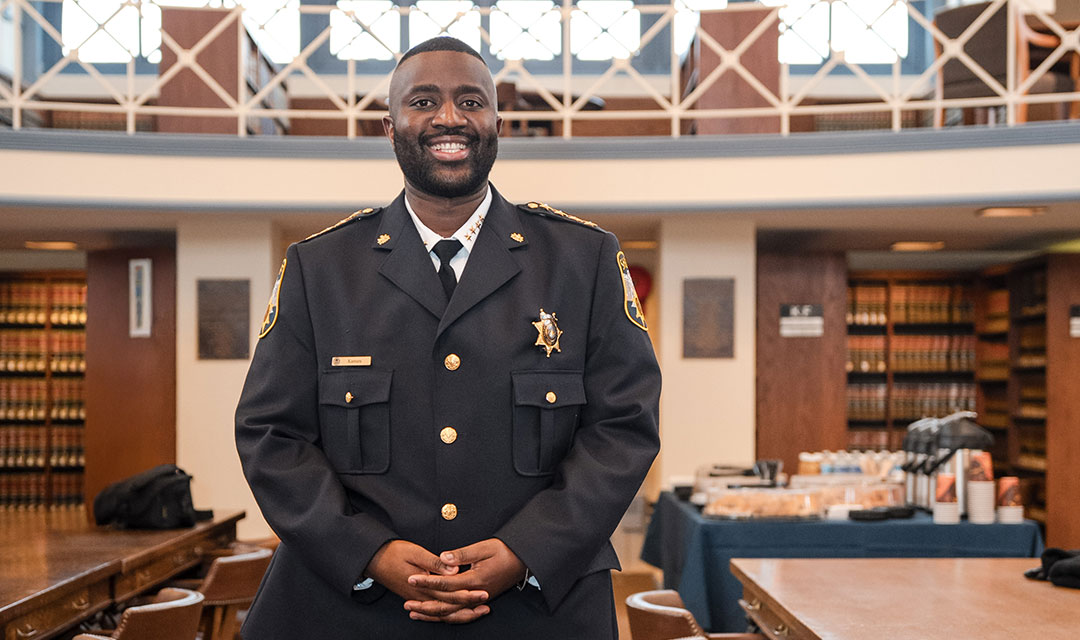
When Siddiq Kamara ’21 talks about leadership, he doesn’t start with titles. He starts with service.
“This country gave back so much to my family,” he said. “Because of that, we’re able to live and really enjoy the American dream. And I wanted to give back and serve my country and the people of my community.”
A first-generation Liberian American, Kamara’s path to becoming Delaware County sheriff, the youngest in the nation and the first African immigrant elected sheriff in Pennsylvania, was shaped long before he took office. His family fled Liberia’s civil war, which claimed nearly 250,000 lives, and settled first in Omaha, Nebraska, before moving to Upper Darby. There, he experienced a level of diversity that would later shape his approach to policing.
“I was looking for a phenomenal university. I needed something that would give me a good work-life balance, and I found that with Immaculata.”
Siddiq Kamara ’21
At 17, he enlisted in the Pennsylvania Army National Guard, beginning a career rooted in service. After completing his training there, he joined the Yeadon Police Department, where he quickly found purpose in community engagement, using cultural awareness and communication to connect with residents and defuse tense situations.
Within a year, Kamara was recommended to the Pennsylvania Office of Attorney General, launching a career that included narcotics investigations, executive protection for then-Attorney General Josh Shapiro and work with a federal joint terrorism task force.
But even as his responsibilities grew, Kamara remained committed to strengthening his educational foundation, pursuing his degree at Immaculata University while balancing the demands of full-time work and continued service in the Pennsylvania Army National Guard.
“I was looking for a phenomenal university,” he said. “I needed something that would give me a good work-life balance, and I found that with Immaculata.”
Kamara recognized Immaculata as a military-friendly institution whose flexibility made it possible to balance his education with the demands of full-time work and service. Just as important, the University’s strong financial aid support made it feasible for him to complete his degree and continue advancing his career.
Beyond accessibility, his courses had a lasting impact on how Kamara leads today.
“[They] enhanced my leadership,” he said, explaining that he has used things he learned at Immaculata to train his deputies and staff.
“Sometimes you’re using these skills you refined and learned, and you don’t even know that you’re doing it,” he said. “But more than ever… that degree really matters.”
That foundation, rooted in education, service and a commitment to thoughtful leadership, would soon be tested in ways he never expected.
In August 2021, amid a period of national unrest, a personal tragedy struck when Kamara’s 8-year-old cousin, Fanta Bility, was killed after police fired toward a crowd following a reported shooting at a football game in Sharon Hill. The loss, he said, clarified his sense of purpose.
In the aftermath, Kamara focused on guiding his community forward with steadiness, prioritizing unity, open dialogue and accountability through the legal system. In doing so, the experience deepened his resolve to strengthen the systems he serves. He now advocates for more consistent and comprehensive law enforcement training, both within his office and across the profession.
That focus is reflected in his broader approach to leadership, which is grounded in four pillars: accountability, empathy, communication and mentorship.
“Having conversations, that’s the first thing,” he said. “People don’t communicate, and I think that’s really problematic.”
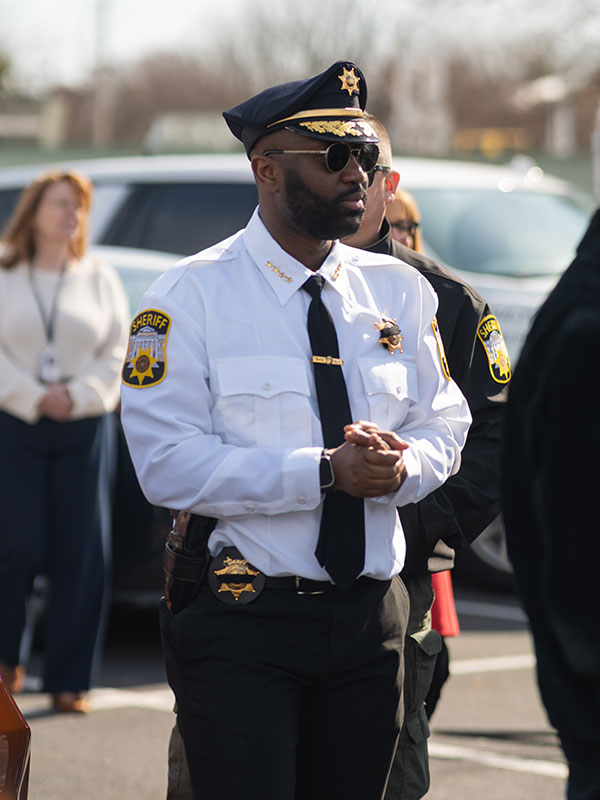
Kamara has begun work to bridge divides by bringing together police chiefs, labor leaders and community stakeholders, building relationships before tensions rise. His emphasis on communication is closely tied to his belief in shared responsibility in leadership.
“I always say it’s not about ‘I,’ it’s about ‘we,’” he said. “You have to allow your deputies to also lead and be by their side.”
Having risen through the ranks, from private in the military to rookie officer, special agent and now sheriff, Kamara believes credibility comes from experience and example.
“I didn’t start from third base,” he said. “I wasn’t even on the field. I’ve been there, done that and I make sure to lead by example, showing what’s expected at every level.”
Leading by example also means leading with empathy, a principle that has remained central to Kamara’s leadership. Early in his career as a Yeadon police officer, he stopped a driver with multiple violations. Instead of issuing fines, he listened.
“He’s crying… he’s like, ‘My wife just died and I’m trying to arrange the funeral,’” Kamara said.
Kamara used discretion, allowing the man to leave his car safely and even giving him $10 for the trolley. Years later, the man told him that moment had changed—and likely saved—his life.
“You don’t know what someone is going through,” he said.
That mindset carries into his office, where he prioritizes mental health and work-life balance as well as getting the job done.
“Your family comes first,” he said. “If you can’t do that, you can’t do your job.”
As sheriff, Kamara is also focused on modernization and training. His office maintains accreditation standards while expanding leadership development and scenario-based exercises. He is also advocating for countywide improvements, including more frequent firearms qualifications and enhanced real-world training.
Even as he leads, Kamara stresses that leadership is never a solo effort. He credits mentors including State Sen. Anthony Williams, Anthony Moss of Laborers Local 413, and Monica Taylor, Ph.D., former chair of Delaware County Council.
“Those three individuals have been phenomenal mentors to me with regard to politics,” he said.
In law enforcement, he points to Yeadon Police Chief Henry Giammarco Jr. as an early supporter and ongoing advisor.
“He believed in me from the start,” Kamara said.
Today, he also leans on a strong team within his office.
“I couldn’t do this work without my team,” he said. “You need really good people around you when you’re going through trials and tribulations. My chief of staff, Sarah Charles, she’s phenomenal. My chief deputy, Bob Weber… the list goes on. My team makes my job easier so I can get the work done.”
Looking ahead, Kamara isn’t focused on legacy in the traditional sense. Instead, he measures success by impact—on his deputies, his community and those who may follow in his footsteps. For students and aspiring leaders, his message is both practical and personal: “Make it a great day or not, the choice is yours,” he said. “Because it’s not where you start, it’s where you finish.”
Photos by Johnathan Kolleh, digital media specialist from the Delaware County Sheriff’s Department.