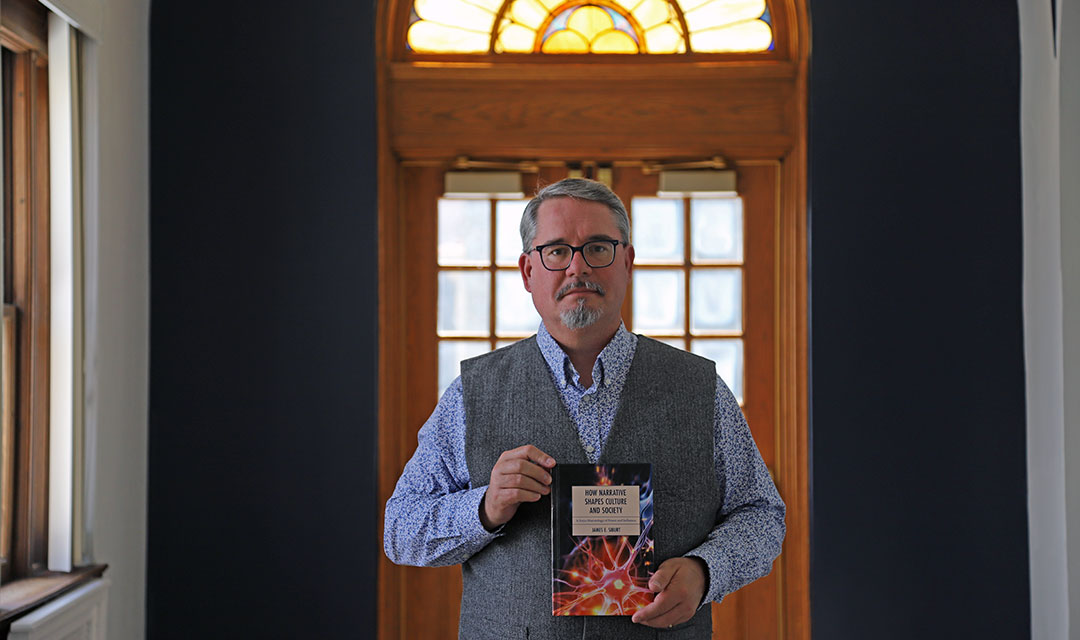
“Why can individuals interpret the same situation in completely different ways, yet each interpretation feels internally coherent?” is the question that, for James Siburt, Ph.D., Immaculata University associate professor and graduate director of the Master of Strategic Leadership program, sparked a deeper exploration and curiosity into how people understand the world around them.
It ultimately led to his writing “How Narrative Shapes Culture and Society: A Socio-Narratology of Power and Influence,” a book that examines how narratives do more than tell stories.
“At its core, the book examines how narrative reflects and stabilizes the conditions under which people understand reality, relate to one another and coordinate action,” Siburt said.
With more than 15 years of experience in higher education as an educator, researcher and administrator, Siburt’s interdisciplinary work focuses on the semiotic analysis of narrative, exploring how folklore, pop culture, religion and mythology shape and perpetuate perspectives in leadership, politics and society.
His research challenges the common assumption that stories merely reflect culture. Instead, he argues that narratives participate in organizing it, rendering visible what feels meaningful, what seems possible and what appears legitimate within an underlying structure of social coordination. These shared narratives operate across institutions, communities and organizations, guiding behavior and stabilizing meaning.
“Rather than approaching leadership or culture as a set of individual choices, I explore how people move within structured environments of meaning, often expressed through narrative, that have already organized expectations,” Siburt said.
Drawing from semiotics and classical sociological theories of collective belief and social cohesion, Siburt also examines how power operates in less visible ways. Rather than direct persuasion, he argues, influence often works by shaping what people take for granted, what feels “normal,” “true” or “appropriate.”
“One of the more surprising insights was how little influence depends on direct persuasion,” Siburt said. “More often, influence operates by shaping the structured environment in which those arguments are interpreted, often prior to conscious deliberation.”
When a narrative becomes widely shared, it no longer requires constant reinforcement. Instead, it becomes embedded in how people recognize situations and make decisions, quietly guiding action. Individuals may feel they are making independent choices, but those decisions are already shaped by what is perceived as meaningful or legitimate.
That shift, from persuasion to structure, became a turning point in Siburt’s research and continues to inform his approach to leadership and teaching.
In the classroom, Siburt moves beyond traditional models that emphasize individual traits or decision-making techniques. Instead, he encourages students to examine the environments in which decisions occur and the narratives that express and reinforce them.
“Students are encouraged to see leadership not just as what a person does, but as how they engage with and reshape the systems of meaning around them,” he said.
This approach is reflected in his graduate course, “Power and Influence,” which explores these ideas in practice. While the course introduces students to applied concepts, his book provides a deeper theoretical foundation.
Siburt’s work also highlights how narratives function as a form of power. Rather than simply communicating ideas, narratives shape how those ideas are interpreted, influencing what is considered a reasonable explanation, a legitimate action or even a recognizable problem.
“A well-established narrative does not need to instruct people what to do; it reflects a structured set of expectations in which certain actions feel appropriate and others unlikely,” he said.
These dynamics extend across time and culture. Siburt notes that enduring works remain relevant not just because of their themes, but because they are structured in ways that allow each generation to reinterpret them. In his own teaching, he draws on the works of Chaucer, as well as fairytales, folktales, parables and science fiction, to illustrate how narratives continue to shape meaning over time.
Bias, too, plays a critical role in this process. Rather than viewing bias solely as an obstacle, Siburt sees it as part of how meaning is structured and recognized within shared environments. Individuals interpret stories through prior experiences and cultural frameworks, but those interpretations are also shaped by broader, shared environments.
“Understanding this helps us move beyond the idea that bias is only something to eliminate,” he said. “It also becomes something to analyze.”
Siburt’s research reframes how leadership is understood. A “good” leader, he explains, is not simply someone who tells compelling stories, but someone who recognizes how meaning is already organized within a group and can work within or reshape that structure.
“Leadership is less about imposing a vision and more about aligning actions with a shared understanding that others recognize as legitimate,” he said.
When that alignment is present, leadership appears coherent and effective. When it is not, even well-intentioned actions may be misunderstood or resisted.
Narrative is not just a tool for communication, he believes, but the foundation through which influence operates and coordinated action becomes possible. His work underscores the central idea that understanding how stories reflect and stabilize meaning is essential to understanding how structured change becomes possible in society.