When most people recall Chester County battles of the American Revolution, the Battle of Brandywine and the Battle of Paoli often take center stage. Yet just days after Brandywine, another encounter unfolded across the rolling landscape of present-day West Goshen, East Goshen and West Whiteland townships. In fact, the brief clash that would come to be known as the Battle of the Clouds, occurred on what is now Immaculata University’s campus.
Bill Watson, Ph.D., professor of history at Immaculata University and director of the Duffy’s Cut Project, wrote a pamphlet on the Battle of the Clouds that, along with insights from John Futhey and Gilbert Cope’s, “History of Chester County” (1880), explores the battle and examines what could have been a potentially catastrophic blow to the Continental Army.
In September 1777, nearly 250 years ago, British and American forces converged along the same roads we still travel today. What followed was not a traditional, single-location battle, but a series of small skirmishes.
After their victory at Brandywine on Sept. 11, British forces under General William Howe remained near Chadds Ford while planning their advance toward Philadelphia. American forces under General George Washington, though weakened, repositioned rapidly across the region in an effort to block Howe’s path and protect the colonial capital.
By Sept. 14, Washington had maneuvered his troops through Great Valley and along the Lancaster-Philadelphia Road, carefully positioning his army between British forces and key crossing points of the Schuylkill River. His line stretched roughly three miles, anchored near landmarks such as the White Horse Inn, with headquarters said to be established nearby at Malin Hall.
On Sept. 15, both armies were on the move again. British forces, numbering approximately 16,000 men, advanced in coordinated columns toward Washington’s position. American troops, estimated at about 10,000 men, prepared for another major confrontation just days after battling at Brandywine.
Small fights broke out as British and Hessian units began to close in on the Continentals. Washington tried to set up a defensive line along high ground near King Road, but by the afternoon of Sept. 16, his forces risked being surrounded on both sides.
Then, as battle lines were being finalized, the weather shifted dramatically.
Ominous, dark clouds rolled in, and a powerful thunderstorm erupted over the battlefield. Rain poured across the region, soaking gun powder, making the muskets useless. It turned the roads into muddy messes, with accounts at the time alleging that the storm halted both armies in their tracks. Even potential bayonet advances were stopped by the conditions.
What might once again have become a decisive British victory, was halted. Under the cover of the storm, Washington ordered a withdrawal. The Continental Army retreated through the sodden terrain, regrouping first at Yellow Springs (now Chester Springs) before continuing toward Warwick Furnace to resupply.
The British remained near the White Horse Inn area in the aftermath, while the fighting itself effectively dissolved under the weather.
The Battle of the Clouds was costly in its own way. American forces suffered losses in ammunition after rain destroyed thousands of cartridges made unusable by inadequate protection. British forces, though better supplied, also found their ability to maneuver and fight severely limited by the storm.
In total, each side is believed to have lost roughly 100 soldiers across the scattered fighting of the day preceding the storm.
When asked why people still care about an almost-battle, Watson states, “Because it was a lesser known but critical battle of the Philadelphia campaign of 1777, in which Washington faced great odds, lost on the battlefield but managed to keep the Continental Army together.”
He also emphasized its significance, not only to the war itself, but also to Immaculata University.
“The details of the order of battle are recorded, and Washington’s forces were positioned on the side of King Road where Immaculata now stands, and the British were positioned across King Road where the IHM Sisters are, and Villa Maria Lower School is located.”
Watson noted that physical evidence of the battle surfaced in the area.
“In 1999, a British cannonball and British officer’s cross belt buckle were located during construction near the Infant Christ statue on back campus, behind Villa Maria Hall,” he said. “Those artifacts are on display at the IHM Mother House.”
Additional discoveries have reinforced the site’s historical importance.
“In the past, burials of dead soldiers from both sides of the battle have been found on properties adjacent to the campus,” Watson said. “Washington and other Continental Army officers and thousands of Patriot soldiers were on our campus — before it was a campus — trying to defend the Revolutionary cause.”
He added that more recent efforts have uncovered even greater evidence of the battle’s presence.
“In 2019 one of my internship students used the Duffy’s Cut metal detector in the area between the Faculty Center, Loyola and Alumnae Hall and located artifacts,” Watson said. “These included buckles, buttons, bullets and bayonets.”
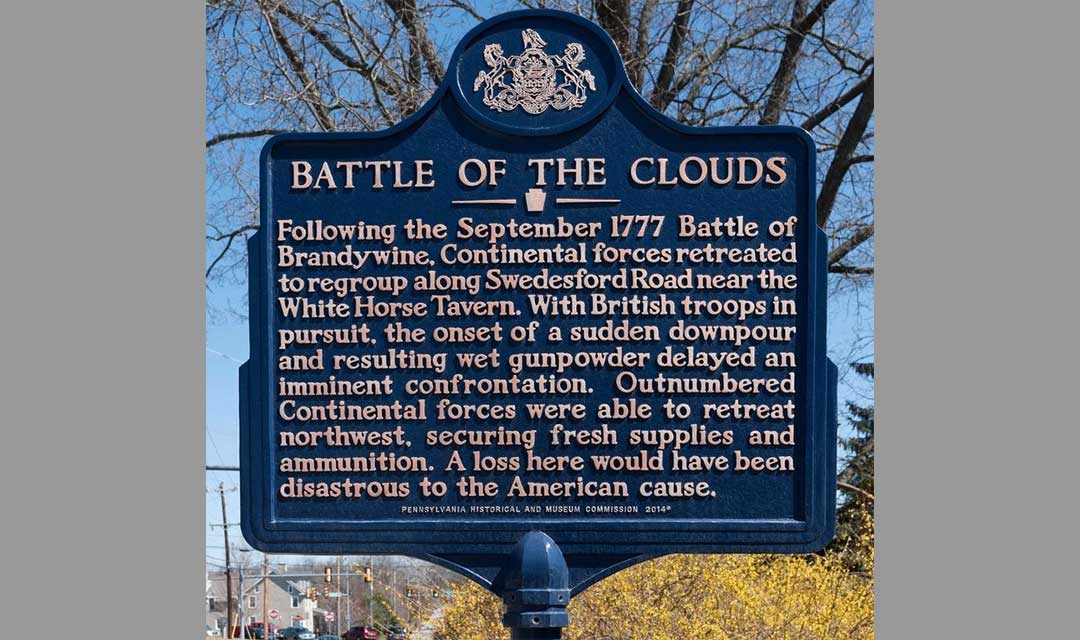
These artifacts serve as reminders that the past still lies just beneath the surface at Immaculata University. A historical marker stands near Villa Maria Hall, commemorating the area where much of the action is thought to have unfolded.
As history suggests, the Battle of the Clouds was as much about timing and terrain as it was about tactics. In the end, it was the weather—seen by some as providential—that ultimately shaped the outcome, altering the course of events that would go on to influence history as we know it today.